
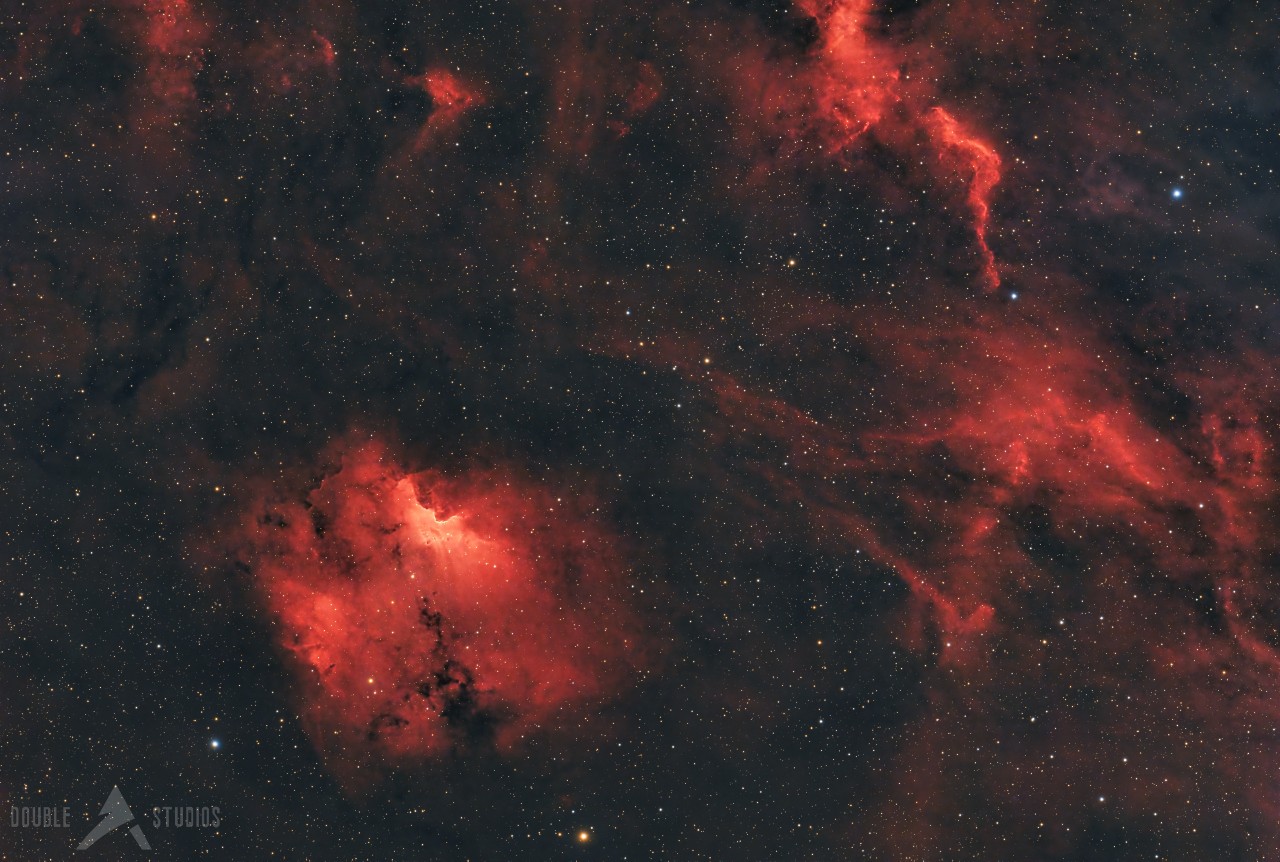
Sh2-135
Observation Summary
28-30 July 2024
51% -> 29%
22h 55m 54s / +62° 33′ 00″
Not applicable (diffuse emission nebula; very low surface brightness)
∼25′ × 20′
Summary
Emission nebula
Sh2-135
Northern
Cepheus
∼10,000 light-years
Technical Details
ZWO AM5
Askar 107PHQ
ZWO ASI294MC-Pro
Optolong L-Ultimate
Askar OAG
ZWO ASI220MM Mini
ZWO ASIAIR Plus
14 h 30 min
PixInsight
Luxembourg
Sh2-135: A compact H II region at the edge of a molecular cloud
Sh2-135 (Sharpless 2-135) is a faint but physically instructive emission nebula located in the northern constellation Cepheus. It is an H II region—a volume of ionised hydrogen gas created by ultraviolet radiation from young, hot stars embedded in or adjacent to a molecular cloud.
While far less visually prominent than giant nebulae such as Orion or the North America Nebula, Sh2-135 represents a far more typical mode of star formation in the Milky Way: compact, localised, and closely coupled to its natal cloud.
Objects like Sh2-135 dominate the Galaxy’s star-forming budget. They lack the dramatic scale of massive complexes, yet they are where stellar feedback, cloud erosion, and continued star formation interact on manageable, parsec-scale dimensions.
Discovery and cataloguing
Sh2-135 was identified in the mid-20th century as part of the Sharpless catalogue of H II regions, compiled by Stewart Sharpless using wide-field photographic plates sensitive to hydrogen-alpha emission. The catalogue was designed to map ionised regions along the northern Milky Way that were difficult to detect visually but revealed themselves clearly in emission-line surveys.
As with many Sharpless objects, Sh2-135 owes its recognition to photographic and spectroscopic techniques rather than telescopic visibility. Its classification as an H II region rests on its strong hydrogen recombination emission and its association with hot, young stars capable of sustaining ionisation.
Main characteristics
Sh2-135 lies within the Galactic disc, at a distance of several kiloparsecs from the Sun, placing it thousands of light-years away and well beyond the local neighbourhood of nearby molecular clouds. Published distances vary depending on the method used—photometric estimates of exciting stars, radio observations, and catalogued associations—but all place the nebula firmly in the Milky Way’s star-forming disc.
Physically, Sh2-135 is compact compared with giant H II regions. The brightest ionised structures span only a few parsecs, corresponding to a handful of light-years, though faint surrounding emission can extend further depending on wavelength and sensitivity. This scale reflects the modest luminosity of its ionising source and the confined nature of the surrounding molecular material.
The nebula sits along a line of sight rich in Cepheus molecular clouds, in a region where low- and intermediate-mass star formation is widespread. Sh2-135 is therefore best understood not as an isolated object, but as one active node within a broader star-forming environment.
Structure and composition
The emission from Sh2-135 is dominated by ionised hydrogen, with additional contributions from ionised oxygen and sulphur tracing variations in excitation and density. Its morphology is irregular rather than spherical, shaped by strong density contrasts within the parent cloud.
Bright rims and curved arcs mark ionisation fronts, where ultraviolet radiation encounters denser gas. In these regions, the ionised plasma is confined and compressed, enhancing emission. Elsewhere, ionised gas expands more freely into lower-density surroundings and becomes diffuse.
Dark dust features appear in silhouette against the nebular glow, indicating the presence of cold, dense material that has not yet been eroded. This geometry—ionised gas flowing off the surface of a denser cloud—is characteristic of so-called blister-type H II regions, a common configuration in Galactic star formation.
Stellar population
The ionisation of Sh2-135 is driven by one or more young, hot stars, most likely of late O-type or early B-type. Such stars emit copious ultraviolet radiation but are less extreme than the most massive O-stars found in giant nebulae, naturally limiting the size of the ionised region.
Infrared surveys of the surrounding area reveal additional young stellar objects embedded in or near the molecular cloud, indicating that Sh2-135 is part of an ongoing star-formation episode rather than a single isolated event. The coexistence of ionised gas, embedded stars, and dense neutral material illustrates the transitional nature of the region: some gas has already been cleared, while other pockets remain capable of further collapse.
Feedback and local dynamics
On the scale of Sh2-135, stellar feedback is dominated by photoionisation rather than by powerful stellar winds or collective cluster effects. Ultraviolet radiation heats and ionises the gas, driving expansion away from the cloud surface and slowly eroding the surrounding material.
This process can have competing outcomes. In some locations, the advancing ionisation front may compress neutral gas, increasing its density and potentially favouring collapse. In others, gas is simply dispersed, reducing the available material for future star formation. Sh2-135 therefore provides a useful case study for examining how feedback operates in relatively simple, small-scale environments.
Future evolution
Sh2-135 is a short-lived structure on astronomical timescales. As its ionising stars evolve and their ultraviolet output declines, the nebula will gradually fade. Ionised gas will recombine, and the remaining material will mix back into the surrounding interstellar medium.
If the most massive stars in the region end their lives as supernovae, they will inject additional energy and heavy elements into the local environment. More likely, however, Sh2-135 will dissolve quietly, leaving behind a loose stellar association and a reshaped molecular cloud.
Observing Sh2-135
Sh2-135 is located in Cepheus, a constellation rich in northern Milky Way star fields. While the region is well placed for Northern Hemisphere observers, the nebula itself is faint and does not stand out without specialised techniques.
Visually, Sh2-135 is challenging even under dark skies and typically appears, at best, as a very subtle brightening. Narrowband filters, particularly those isolating hydrogen-alpha emission or broad UHC-type filters, are essential for improving contrast.
For astrophotography, the nebula is far more accessible. Hydrogen-alpha imaging readily reveals its structure and separates it from the dense stellar background. Sh2-135 is often treated primarily as an Hα object, with broadband colour added mainly to represent stars and dust rather than strong multi-line emission. Moderate focal lengths are well suited to capturing the nebula together with its immediate environment.
Cepheus is best placed from late summer through autumn, when it is high in the evening sky across much of the Northern Hemisphere.
References
Sharpless, S. (1959). A Catalogue of H II Regions. Astrophysical Journal Supplement Series.
Anderson, L. D. et al. (2014). The WISE Catalog of Galactic H II Regions. Astrophysical Journal Supplement Series.
Bania, T. M. et al. (2010). The Green Bank Telescope H II Region Discovery Survey. Astrophysical Journal.
Urquhart, J. S. et al. (2018). ATLASGAL: properties and distances of Galactic H II regions. Monthly Notices of the Royal Astronomical Society.