

Needle Galaxy (NGC 4565)
Observation Summary
20-27 April 2022
86.6% -> 15.8%
12h 36m 20.8s / +25° 59′ 15″
∼9.6
∼15.9′ × 2.1′
Summary
Barred spiral galaxy (edge-on)
NGC 4565
Northern
Coma Berenices
∼40 million light-years
Technical Details
Sky-Watcher HEQ5-Pro
Askar 107PHQ
ZWO ASI294MC-Pro
Optolong L-Pro
Optolong UV/IR Cut
AstroEssentials 50/200
ZWO ASI174MM
ZWO ASIAIR Plus
L-Pro: 54 × 600 s
UV/IR: 20 × 180 s
10 h
PixInsight
Luxembourg
NGC 4565, widely known as the Needle Galaxy, is a striking example of an edge-on spiral galaxy located in the constellation Coma Berenices, a modest northern constellation associated with the broader Coma Supercluster of galaxies. Situated at an estimated distance of between 30 and 50 million light-years from Earth, depending on the adopted distance indicator, it ranks among the closer and better-resolved large spiral galaxies available for detailed study.
NGC 4565: A Needle in the Cosmic Haystacks
Measuring about 175,000 light-years across, NGC 4565 is larger than the Milky Way in diameter, and provides a grand-scale model of spiral galaxy structure. The galaxy’s highly flattened stellar disc, bisected by a prominent dust lane and punctuated by a bright central bulge, renders it an exemplary case for analysing the vertical structure of galactic discs. Its nearly perfect edge-on orientation is particularly valuable for investigating phenomena such as the distribution of interstellar dust, the thickness of stellar populations, and the dynamics of galactic warps.
Because of its symmetry, minimal foreground contamination, and structural clarity, NGC 4565 is frequently cited in comparative studies of spiral galaxies and remains a fundamental reference object for understanding galactic morphology, disc-halo interactions, and the secular evolution of massive disc galaxies.
Discovery and Classification
NGC 4565 was discovered by Sir William Herschel on 6 April 1785 during one of his systematic surveys of the night sky. Using his 18.7-inch reflecting telescope, Herschel catalogued the object as a faint, elongated patch of light. At the time, its true nature was not yet understood, as the concept of galaxies beyond the Milky Way would not be confirmed until the twentieth century.
In modern classification systems, NGC 4565 is catalogued as type SA(s)b?, indicating a spiral galaxy with moderately tight arms, no ring structure, and an uncertain presence of a central bar. Observations in the infrared by the Spitzer Space Telescope have revealed that the galaxy does indeed possess a bar structure, hidden by our edge-on perspective.
Structure and Composition
NGC 4565 exhibits a complex and layered structure characteristic of large spiral galaxies. Its most prominent feature is the thin, edge-on disc, which contains a significant amount of interstellar matter, including neutral hydrogen, molecular gas, and prominent dust lanes visible in optical images. The dust, composed mainly of silicates, carbon compounds, and ices, plays a crucial role in the ongoing process of star formation. Infrared observations, particularly from the Spitzer Space Telescope, have revealed a central bar and an inner ring structure, confirming that NGC 4565 is a barred spiral galaxy.
The galaxy's disc is slightly warped, a feature more apparent in radio observations, and likely resulting from gravitational interactions with neighbouring galaxies or the accretion of intergalactic material. Additionally, NGC 4565 possesses a substantial stellar halo composed of older stars and a rich system of globular clusters, extending far beyond the visible disc. The halo’s composition and structure provide important insights into the galaxy's formation history and its interactions within the Coma I Group.
NGC 4565's mass is estimated to be around 200 billion times that of the Sun. Its thin stellar disc contains both young and intermediate-age stars, interspersed with regions of active star formation, particularly in the spiral arms. In addition to its disc, the galaxy hosts a bright, spheroidal bulge composed mainly of older, metal-rich stars, suggesting a long and complex evolutionary history.
Structural Features
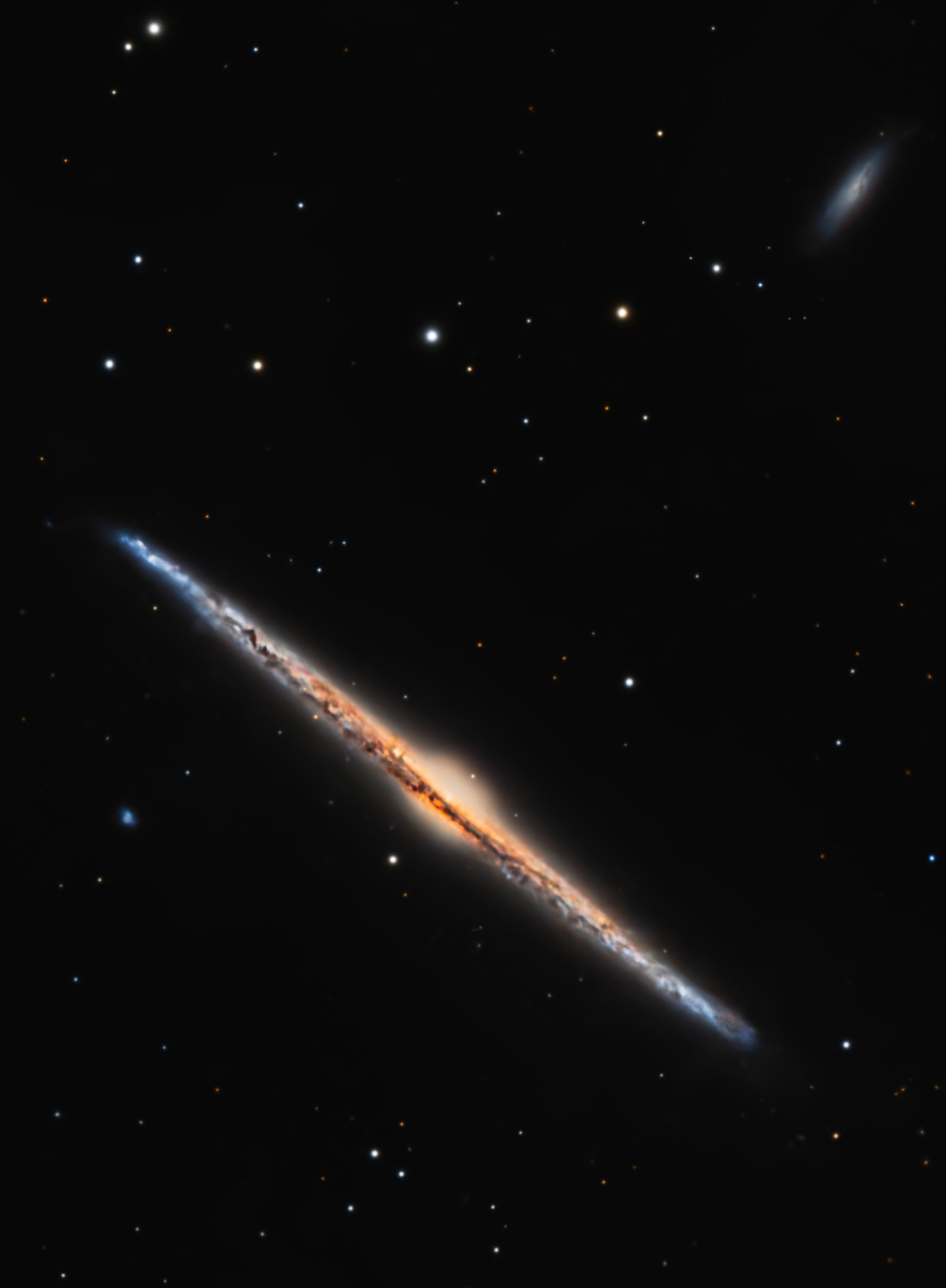
One of the most fascinating aspects of NGC 4565 is the nature of its central bulge. Infrared observations have shown that the bulge is a pseudobulge, formed through internal, gradual processes known as secular evolution, rather than violent mergers. John Barentine and John Kormendy highlighted that the central light concentration is dynamically cool, indicating a pseudobulge rather than a merger-built classical bulge.
This suggests that NGC 4565 has had a relatively peaceful evolutionary past, at least in its later stages. The galaxy's disc is slightly warped, a feature confirmed through radio observations. Warps in galactic discs are often the result of gravitational interactions with neighbouring galaxies or the accretion of intergalactic gas. As García-Ruiz et al. noted, the warp seen in NGC 4565 suggests a long-term process of accretion or minor merging, rather than major disruptive events.
Stellar Population
The stellar population of NGC 4565 is diverse, reflecting different stages of stellar evolution. The central pseudobulge is dominated by older, metal-rich stars, indicative of a mature population, while the disc contains a mixture of younger stars, with ultraviolet and infrared observations revealing regions of active, massive star formation.
Studies of the galaxy's globular clusters, numbering approximately 240, reveal a population of ancient stars that provide crucial information about the early stages of NGC 4565’s development. These clusters are more numerous than those in the Milky Way, suggesting a richer and possibly more active early history. Spectroscopic analyses show variations in metallicity and age among the clusters, pointing to multiple episodes of star formation and accretion throughout the galaxy’s lifetime.
Galactic Environment
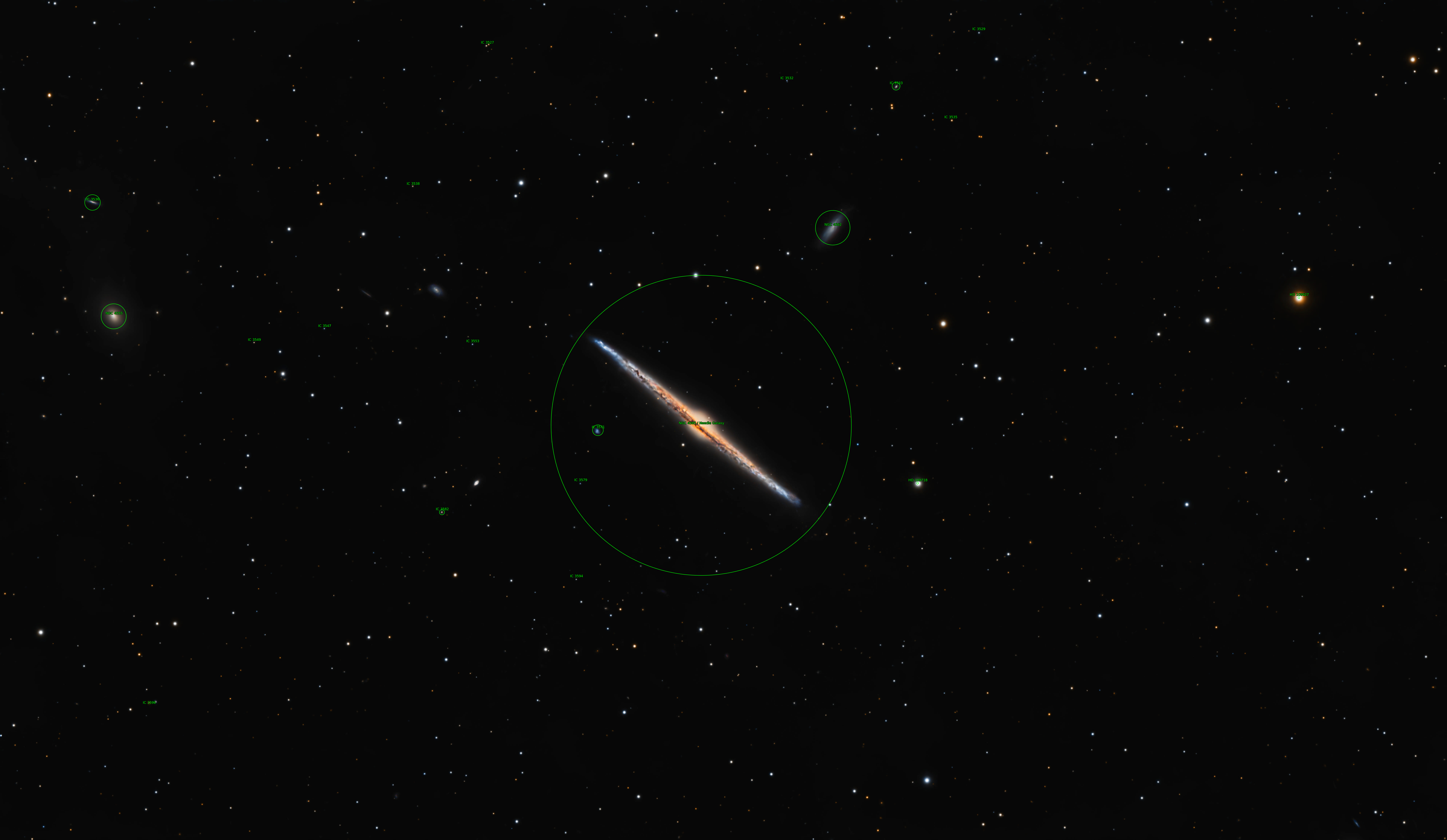
NGC 4565 resides within the Coma I Cloud, a loosely bound group of galaxies located much closer than the more distant Coma Cluster. It is the brightest member of this group and is known to have at least two dwarf satellite galaxies, NGC 4562 and IC 3571. Evidence of gravitational interaction with these satellites is visible in the slight asymmetry of the outer disc warp.
The extensive population of globular clusters surrounding NGC 4565 provides additional evidence for its dynamic past. The Webb Deep-Sky Society observed that the unusually large number of globular clusters could imply past merger events or early, rapid star formation episodes, suggesting that while NGC 4565’s recent history may be relatively calm, its earlier phases were likely more active.
Observational Highlights
Multifrequency observations have continued to reveal new details about NGC 4565. Radio surveys, particularly those using the LOw-Frequency ARray (LOFAR), have detected a diffuse radio halo extending several kiloparsecs above and below the galactic plane. This halo suggests ongoing cosmic ray propagation and weak galactic winds, remnants of past star formation. According to Heesen et al., the radio halo and warped disc provide evidence of a dynamic, evolving system.
X-ray observations have revealed faint emissions from hot gas above the disc, consistent with a galactic fountain process, where gas is expelled by supernova explosions and eventually falls back into the disc. Optical and infrared imaging have allowed astronomers to separate the thin disc, thick disc, and stellar halo components, offering a comprehensive vertical profile of the galaxy. Surface photometry studies indicate that the thick disc, composed of older stars, extends further from the galactic plane than the thin disc, providing clues about the dynamical history and star formation processes in the galaxy.
Future Evolution
While NGC 4565 currently exhibits a relatively stable structure, its future evolution will continue to be shaped by both internal dynamics and external interactions. The presence of a central bar and pseudobulge suggests that secular processes will gradually redistribute mass and angular momentum, influencing star formation rates and the morphology of the disc over time.
Externally, NGC 4565’s membership in the Coma I Group implies the potential for future gravitational interactions with neighbouring galaxies. Such interactions could induce tidal forces, further warping the disc or triggering new star formation episodes. Over cosmological timescales, these processes could significantly alter the galaxy's structure and stellar content.
Additionally, the galaxy’s dark matter halo will continue to play a central role in its evolution. As NGC 4565 accretes material from its surroundings, its mass distribution may change, influencing its rotation curve and overall stability.
Observing NGC 4565
NGC 4565 can be easily located by first finding the Coma Star Cluster, also known as Melotte 111, a loose open cluster visible to the naked eye in the constellation Coma Berenices. From the cluster, NGC 4565 lies a few degrees to the south-east. Observers should start by identifying the bright stars of the cluster, then sweep slowly south-eastwards with binoculars or a low-power telescope until the faint, elongated streak of NGC 4565 comes into view.
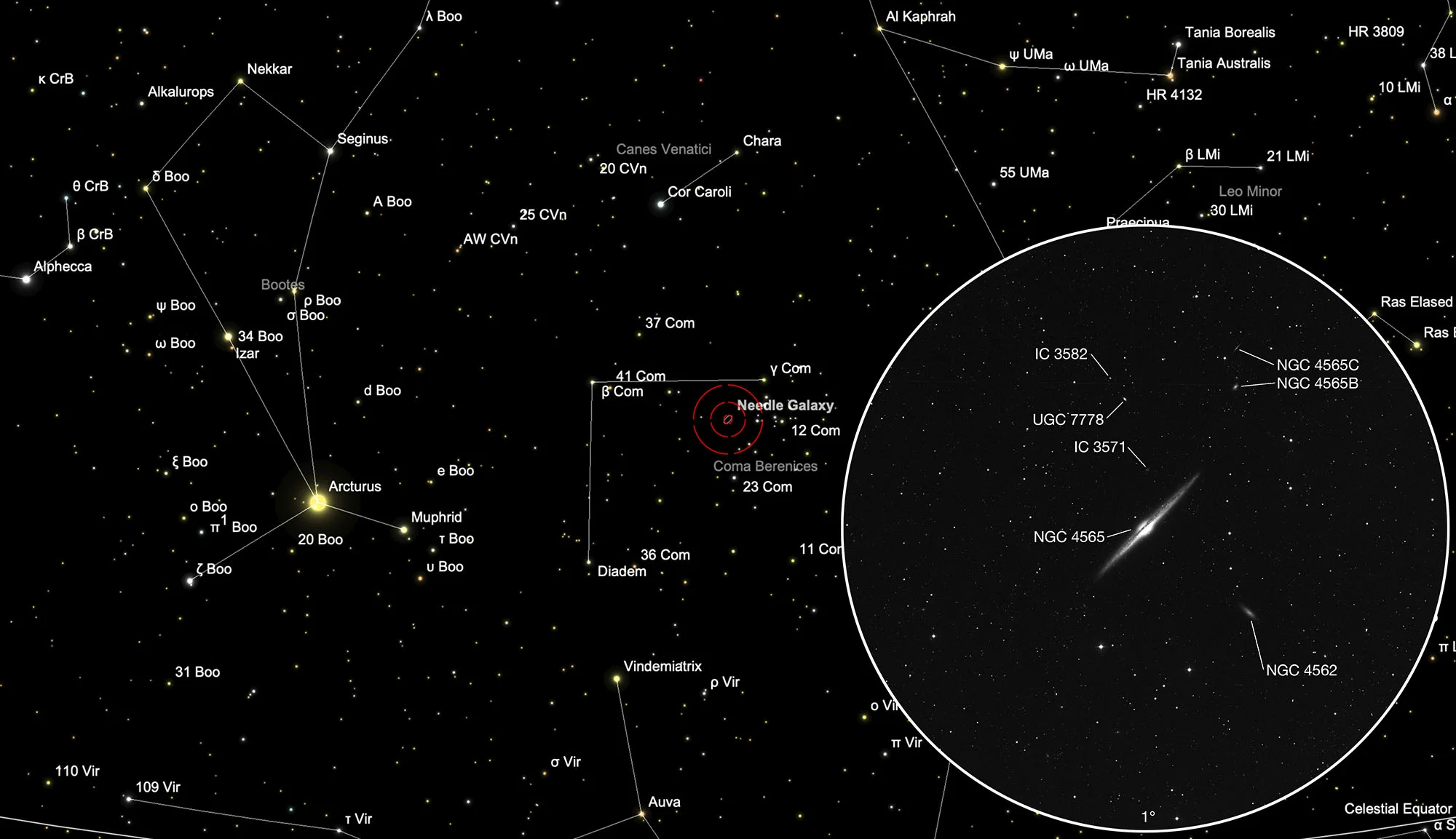
The galaxy is best observed from the Northern Hemisphere during the spring months, particularly from March to May, when Coma Berenices reaches its highest point in the sky around midnight. Its apparent magnitude of approximately 10.42 makes it accessible to amateur astronomers under dark sky conditions: small telescopes can reveal its needle-like shape while medium to large telescopes, with apertures of 8 inches or more, will show the bright central bulge and, under excellent conditions, the prominent dark dust lane dividing the disc.
References
- Barentine, J. C., and Kormendy, J. (2009). Detection of a Distinct Pseudobulge Hidden Inside the Box-Shaped Bulge of NGC 4565.
- García-Ruiz, I., Sancisi, R., and Kuijken, K. (2002). Neutral Hydrogen Warps in Spiral Galaxies. Astronomy and Astrophysics.
- Heesen, V., et al. (2019). Warped diffusive radio halo around the quiescent spiral edge-on galaxy NGC 4565.
- Seth, A. C., Dalcanton, J. J., and de Jong, R. S. (2005). Vertical structure in edge-on galaxies: NGC 4565 as a template. The Astronomical Journal.
- Gendler, R. (2011). Treasures of the Southern Sky.
- Zaritsky, D., and Rix, H.-W. (1997). Chemical Abundances and Gradients in Spiral Galaxies. The Astrophysical Journal.
- Combes, F. (2000). Secular Evolution of Galaxies. In: D'Odorico, S., Fontana, A., Giallongo, E. (eds) Deep Fields. Springer, Astrophysics and Space Science Library.
- Tempel, E., Tamm, A., and Tenjes, P. (2010). Stellar mass and stellar populations in disc galaxies. Astronomy & Astrophysics.