
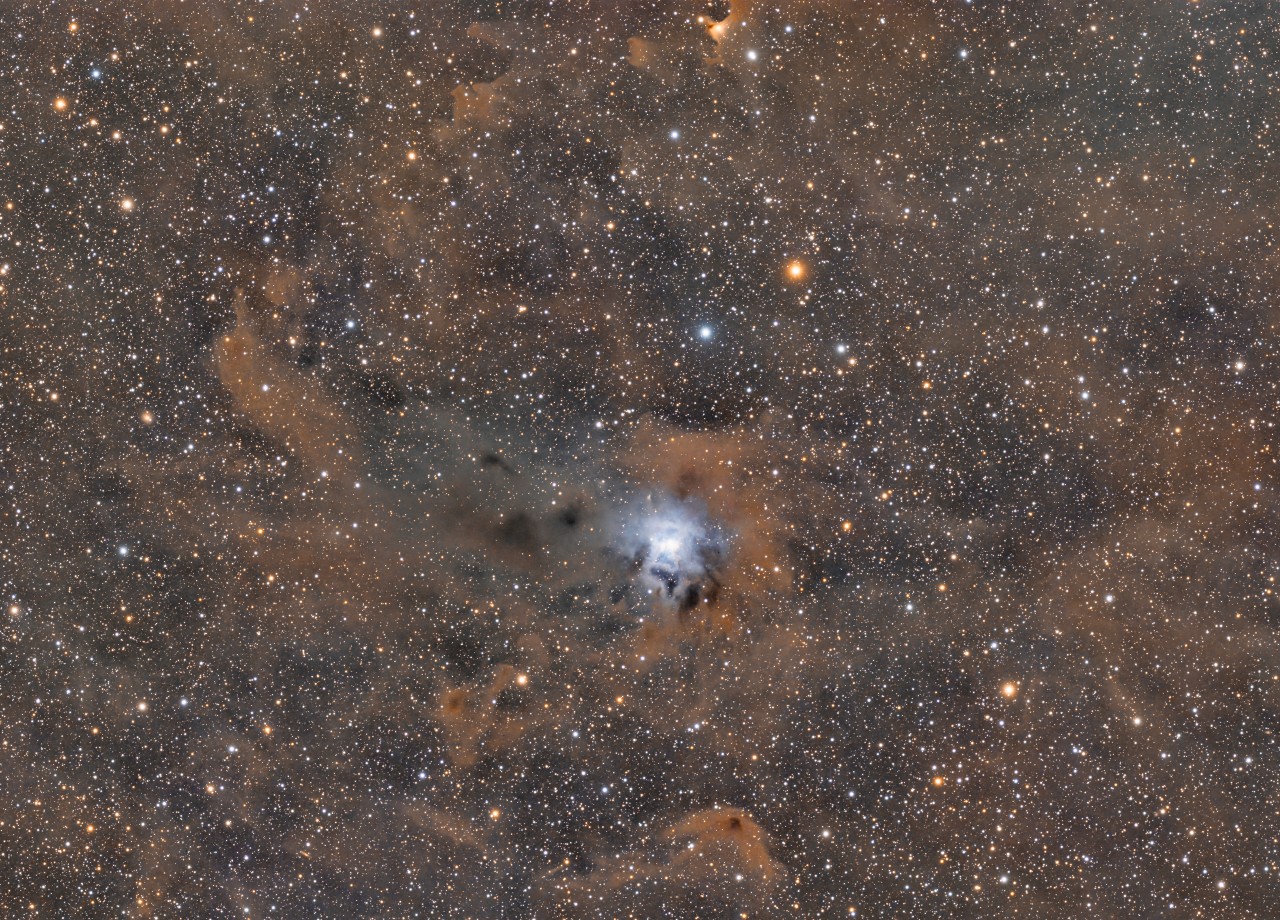
Iris Nebula (NGC 7023)
Observation Summary
10 -> 12 June 2023
59% -> 36.6%
21h 01m 36s / +68° 10′ 10″
∼7.0
∼18′ × 18′
Summary
Reflection nebula
NGC 7023, C 4
Northern
Cepheus
∼1,400 light-years
Technical Details
ZWO AM5
RedCat 51
ZWO ASI294MC-Pro
Optolong L-Pro + UV/IR Cut
WO UniGuide 32
ZWO ASI220MM Mini
ZWO ASIAIR Plus
10 h
PixInsight
Luxembourg
The Iris Nebula: a laboratory of dust, starlight, and interstellar chemistry
The Iris Nebula, catalogued as NGC 7023, is one of the most studied reflection nebulae in the northern sky. Located in the constellation Cepheus, it is best known for its striking blue appearance in astronomical images and for the complex network of dark filaments and glowing ridges surrounding its central star.
Far from being a passive cloud illuminated by chance, NGC 7023 is a dynamic astrophysical environment where radiation, dust, gas, chemistry, and magnetic fields interact on scales of light-years. For astronomers, it represents a nearby and accessible laboratory for understanding how young stars reshape their birth clouds and how complex molecules survive in harsh radiation fields.
Early Observations
NGC 7023 was discovered on 18 October 1794 by William Herschel during his systematic survey of nebulae and star clusters. At the time, telescopes were limited to visual observation, and the nature of nebulae was still unclear. Herschel recorded the object as a faint, diffuse glow associated with a bright star, without any indication of emission lines or stellar condensation.
As astronomical instrumentation improved through the nineteenth and early twentieth centuries, NGC 7023 gradually emerged as a prototype of what would later be called a reflection nebula: a cloud of interstellar dust made visible by the scattering of light from a nearby star rather than by the emission of light from ionised gas.
Distance and physical scale
Determining the distance to the Iris Nebula has historically been challenging, and published values have varied. Many public catalogues and early studies list distances of around 1,300–1,400 light-years, reflecting earlier photometric estimates.
More recent work, however, has benefited from Gaia astrometry, which allows precise distance measurements to stars physically associated with the nebula. Studies focusing on the surrounding dark cloud complex LDN 1172/1174 and its young stellar population consistently place the region at approximately 335 parsecs, corresponding to about 1,100 light-years. This value is now widely adopted in the scientific literature when discussing the physical properties of the nebula and its environment.
At this distance, the brightest part of NGC 7023 spans roughly 6 light-years, while the surrounding dust structures extend farther into the parent molecular cloud.
The illuminating star: HD 200775
The defining feature of NGC 7023 is its central illuminating star, HD 200775, a young, massive Herbig Be star. Such stars represent an intermediate evolutionary stage: they have recently formed, are still interacting with their natal material, and emit strong ultraviolet radiation.
HD 200775 is now known to be a binary system, with two massive components orbiting each other. This binarity adds complexity to the radiation field and dynamical influence exerted on the surrounding nebula. The star’s ultraviolet photons do not ionise the gas strongly enough to produce a classical emission nebula, but they are energetic enough to profoundly affect dust grains and molecular chemistry in the surrounding cloud.
Structure and composition of the nebula
The Iris Nebula owes its characteristic blue colour to wavelength-dependent scattering by interstellar dust grains. Smaller grains scatter shorter (bluer) wavelengths more efficiently, in a process analogous to the scattering that makes Earth’s daytime sky appear blue.
However, the nebula is far from uniform. Dark lanes, cavities, and filamentary structures trace variations in dust density and grain properties. These features reveal the turbulent and clumpy nature of the interstellar medium from which the star formed.
One of the most important scientific aspects of NGC 7023 is the presence of well-defined photodissociation regions, or PDRs. These are transition zones where far-ultraviolet radiation alters the chemistry and heating of the gas without fully ionising it.
The north-western filament of NGC 7023 is a textbook PDR. Moving away from HD 200775, astronomers observe a layered structure: ionised and atomic gas closest to the star, warm molecular hydrogen at the illuminated surface, and colder molecular gas deeper within the cloud.
This stratification allows direct testing of theoretical models describing how radiation penetrates molecular clouds.
Infrared observations reveal strong emission features associated with polycyclic aromatic hydrocarbons (PAHs)—large, flat, carbon-based molecules that are widespread in interstellar space. NGC 7023 has become one of the key reference objects for studying PAHs because its geometry and radiation field are relatively well constrained.
Recent analyses show that variations in PAH emission across the nebula can largely be explained by two dominant factors: the overall abundance of PAHs and their ionisation state, which changes with distance from the illuminating star. This insight simplifies the interpretation of infrared spectra and strengthens the link between observed emission and physical conditions.
In addition to blue reflection and infrared features, NGC 7023 exhibits extended red emission (ERE), a broad photoluminescent glow produced when certain dust components absorb ultraviolet light and re-emit it at longer wavelengths. Although the precise nature of the ERE carrier remains uncertain, the Iris Nebula remains one of the best-studied environments for investigating this phenomenon.
Stellar population
While HD 200775 dominates the nebula visually, it is not alone. The surrounding cloud complex hosts a population of young stellar objects, identified through infrared excesses, X-ray emission, and Gaia kinematics. These stars indicate that star formation in the region is ongoing or has occurred very recently.
This makes NGC 7023 particularly valuable: it captures a moment when massive stars have emerged from their birth material but have not yet fully dispersed their surroundings. The interplay between stellar radiation, winds, and the dense cloud determines whether star formation is quenched or triggered in nearby regions.
Recent advances (last five years)
Gaia-based studies have refined the census of stars physically associated with the nebula, reducing contamination from unrelated foreground and background objects. This has led to more reliable estimates of luminosity, radiation intensity, and physical size.
Observations with the James Webb Space Telescope have provided unprecedented spectral detail across the PDRs of NGC 7023. These data reveal a rich inventory of atomic and molecular lines, as well as absorption features from ices such as water, carbon monoxide, and carbon dioxide in shielded regions. The presence of ices close to an active radiation interface offers new constraints on cloud structure and porosity.
Recent polarimetric studies suggest that stellar feedback from HD 200775 has influenced the local magnetic-field geometry, shaping filaments and guiding the flow of material. This highlights the role of magnetic fields as an often invisible but crucial component of star-forming environments.
Future evolution
NGC 7023 is a transient structure on astronomical timescales. As HD 200775 continues to emit radiation and drive stellar winds, the surrounding dust and gas will gradually be eroded and dispersed. The bright filaments and PDRs will fade as their material is consumed or pushed away.
At the same time, denser clumps within the cloud may continue forming stars. Whether the net effect of the star’s feedback is constructive or destructive depends on local conditions—a balance that NGC 7023 allows astronomers to study in detail.
Observing NGC 7023
The Iris Nebula lies in Cepheus, a circumpolar constellation for much of Europe. Cepheus is located near the familiar “W” of Cassiopeia and close to the plane of the Milky Way.
A practical way to locate NGC 7023 is to identify Cassiopeia and then move toward the region of Cepheus containing moderately bright field stars near the nebula’s position. Star charts or planetarium software are strongly recommended, as the nebula itself is not obvious visually.
For observers in the Northern Hemisphere, NGC 7023 is best observed from late summer through autumn, when Cepheus is high in the evening sky. As a reflection nebula, it is highly sensitive to light pollution and moonlight, thus dark skies are essential for detecting its faint outer structures.
References
Herschel, W. (1794). Original observations of nebulae and clusters.
Alecian, E. et al. (2008). The spectroscopic binary nature of HD 200775. Astronomy & Astrophysics.
Saha, P. et al. (2020). Young stellar population associated with HD 200775 and LDN 1172/1174. Astronomy & Astrophysics.
Sidhu, A. et al. (2022). Principal component analysis of PAH emission in NGC 7023. The Astrophysical Journal.
Elyajouri, M. et al. (2025). JWST observations of photodissociation regions: dust and carbonaceous material. Astronomy & Astrophysics.
Misselt, K. et al. (2025). JWST spectroscopy of PDRs including NGC 7023. Astronomy & Astrophysics.
Sharma, E. et al. (2025). Magnetic fields and stellar feedback in the Iris Nebula. Astronomy & Astrophysics.