

Elephant Trunk Nebula (IC 1396)
Observation Summary
06 October 2022
80.6%
21ʰ 39ᵐ 00ˢ / +57° 30′ 00″
≈ 3.5
≈ 170′ (≈ 3°)
Summary
Emission Nebula
IC 1396
Northern
Cepheus
∼2,400 light-years
Technical Details
ZWO AM5
William Optics RedCat 51
ZWO ASI294MC-Pro
Optolong L-Ultimate
Svbony SV165
ZWO ASI120MM-S
ZWO ASIAIR Plus
75 × 300 s
6 h 15 min
PixInsight
Luxembourg
A Galactic Safari with the Elephant Trunk Nebula (IC 1396)
IC 1396 is a prominent emission nebula located in the constellation Cepheus, approximately 2,400 light-years from Earth. This vast region of ionized gas and interstellar dust spans over 100 light-years, making it one of the largest emission nebulae observable in the night sky.
Discovery and Classification
The nebula was first catalogued in the early 20th century as part of the Index Catalogue (IC), a comprehensive list of nebulae and star clusters. Within IC 1396, the Elephant's Trunk Nebula—designated as IC 1396A—was identified earlier by astronomer Edward Emerson Barnard in 1890. Barnard, renowned for cataloguing numerous dark nebulae, described the Elephant's Trunk for its distinctive elongated shape, which has since made it a subject of extensive study.
Structure and Composition
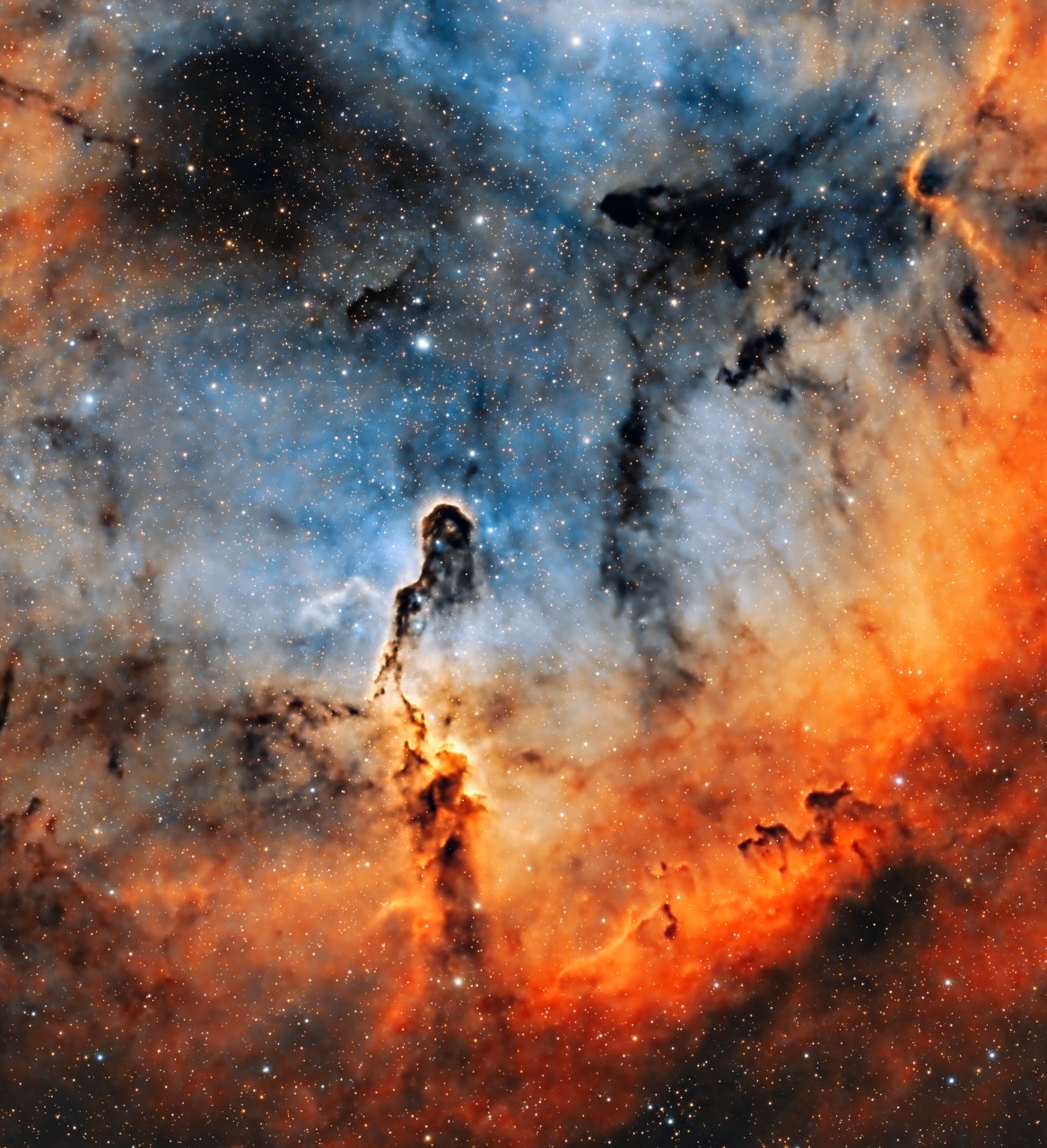
IC 1396 is a dynamic region of glowing ionized hydrogen gas (H II region) interspersed with dark, dense clouds of dust. At its heart lies the open star cluster Trumpler 37, home to massive O-type and B-type stars, including HD 206267. The intense ultraviolet radiation emitted by these stars ionizes the surrounding hydrogen gas, producing the characteristic reddish glow observed in emission nebulae. This radiation also interacts with surrounding molecular clouds, sculpting the nebula into bright rims and dark globules.
One of IC 1396’s standout features is the Elephant's Trunk Nebula (IC 1396A), a dense, elongated structure of gas and dust stretching approximately 20 light-years. Resembling the trunk of an elephant against the luminous backdrop, it serves as an active star-forming region, hosting numerous young stellar objects and protostars. Radiation from the massive stars in Trumpler 37 compresses the gas within the trunk, triggering gravitational collapse and the formation of new stars.
Star Formation and Stellar Population
IC 1396 hosts numerous bright-rimmed clouds (BRCs), dense pockets of gas and dust illuminated by ultraviolet radiation from massive stars. These BRCs and the region's dense globules, known as Bok globules, serve as natural laboratories for studying the early stages of stellar evolution. Recent observations from the Gaia space observatory have revealed multiple subclusters within IC 1396, each with distinct kinematic properties and ages, indicating a complex, multi-episodic history of star formation.
The Elephant's Trunk Nebula is particularly notable for its active star-forming processes. Studies have identified numerous young stellar objects (YSOs) and protostars as well as over 250 young stars within and around the trunk, some of which are less than 100,000 years old. Star formation here is heavily influenced by the radiation and stellar winds from the massive stars in Trumpler 37. These forces compress surrounding gas and dust, triggering gravitational collapse and subsequent star birth, a process known as radiation-driven implosion (RDI).
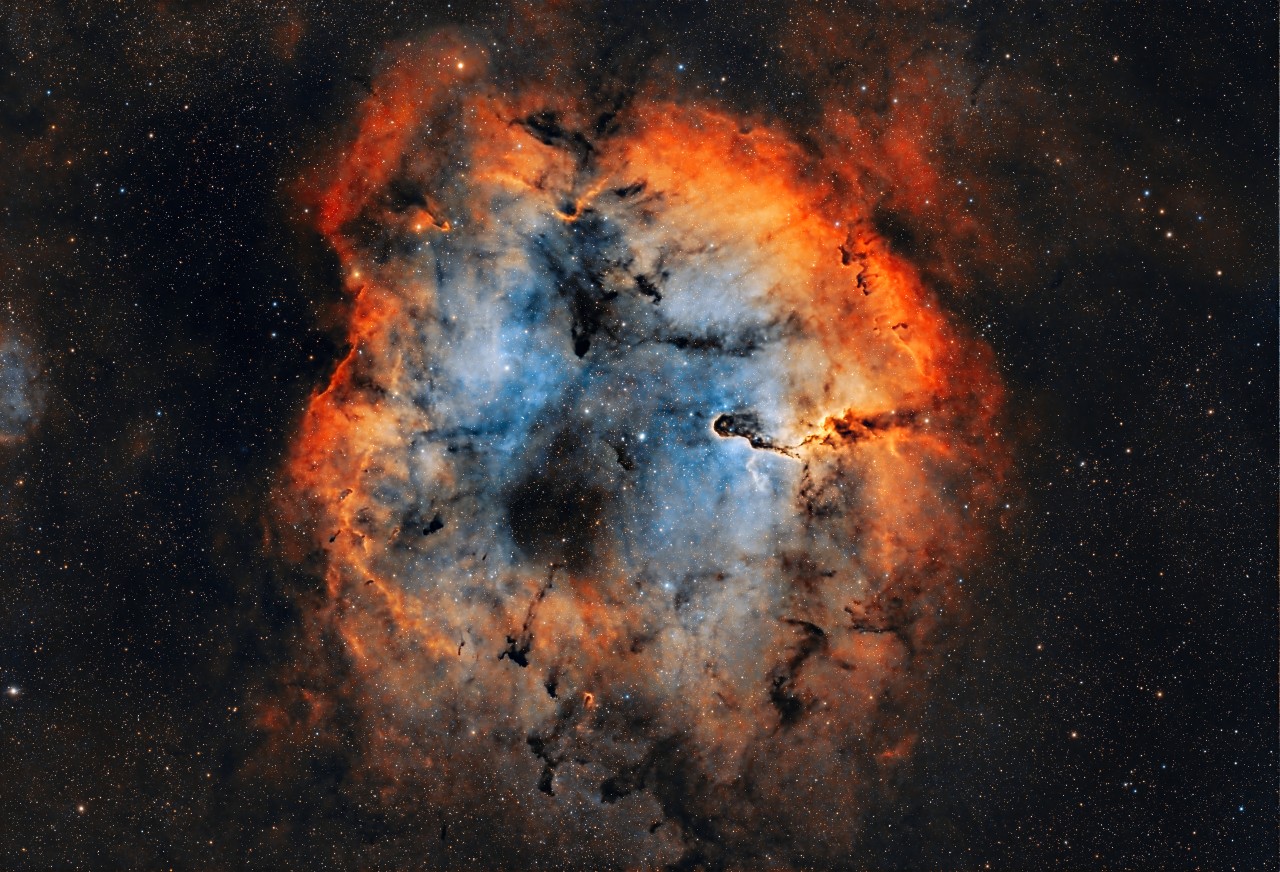
Such regions provide invaluable insights into the mechanisms of triggered star formation. The interplay between ionizing radiation and molecular clouds highlights the dynamic processes shaping star-forming regions. As Mara E. Pelayo-Baldárrago et al. observed, “the kinematics, age, and evolutionary state differences in groups of sources within the same cloud suggest that IC 1396 has undergone more than one star-formation episode over time from various mechanisms”. These findings are critical for understanding the lifecycle of stars and the broader evolution of galaxies.
Observing IC 1396
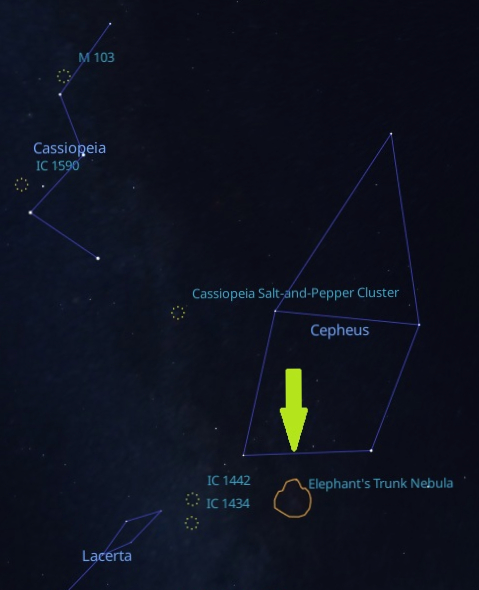 Under dark skies, IC 1396 can be seen with the naked eye as a faint, diffuse patch. However, its intricate structures are best revealed through long-exposure astrophotography or telescopes equipped with narrowband filters. For observers in the Northern Hemisphere, IC 1396 is best viewed during the summer and autumn months when the constellation Cepheus is prominently positioned in the night sky. The nebula spans over three degrees, approximately six times the diameter of the full moon, making it an excellent target for wide-field imaging.
References
- Pelayo-Baldárrago, M. E., et al. "Star Formation in IC 1396: Kinematics and Subcluster Structure Revealed by Gaia." Monthly Notices of the Royal Astronomical Society, 2022.
- Getman, K. V., et al. "X-ray Study of Triggered Star Formation and Protostars in IC 1396N." The Astrophysical Journal, Volume 656, Number 1, 2007.
- Osterbrock, D. E. Astrophysics of Gaseous Nebulae and Active Galactic Nuclei. University Science Books, 2006.
- Bok, B. J., and Reilly, E. F. "Small Dark Nebulae." The Astrophysical Journal, Volume 114, 1951.
- Barnard, E. E. A Photographic Atlas of Selected Regions of the Milky Way. Carnegie Institution of Washington, 1927.
- Spitzer, L., Jr. Physical Processes in the Interstellar Medium. Wiley-VCH, 1978.