

Bode's & Cigar Galaxies (M81, M82)
Observation Summary
31 Jan - 02 Feb 2025
3.2% - > 15.7%
M81: 09h 55m 33s / +69° 03′ 55″
M82: 09h 55m 52s / +69° 40′ 47″
M81: ∼6.9 · M82: ∼8.4
M81: ∼26.9′ × 14.1′
M82: ∼11.2′ × 4.3′
Summary
Interacting galaxies
M81 – M82
Northern
Ursa Major
∼12 million light-years
Technical Details
ZWO AM5
Askar 107PHQ
ZWO ASI2600MC Duo
Optolong L-QEF
ZWO ASIAIR Plus
410 × 180 s
20 h 30 min
PixInsight
Luxembourg
In the northern constellation of Ursa Major, approximately 12 million light-years from Earth, lie two remarkable galaxies: M81, also known as Bode's Galaxy, and M82, commonly referred to as the Cigar Galaxy. Discovered in 1774 by German astronomer Johann Elert Bode, these galaxies have since become focal points in the study of galactic formation, interaction, and evolution.
M81 and M82—Behind the Interacting Duo
Messier 81 and Messier 82 not only offer interesting insights into the dynamics of galactic interactions and their impact, but also stand out for their unique and extraordinary characteristics.
Messier 81 (Bode's Galaxy)

M81, informally known as Bode's Galaxy, is a grand design spiral galaxy that was discovered by Johann Elert Bode, from which it takes the name. M81 exhibits a well-defined spiral structure with prominent arms extending from a central bulge. The galaxy's diameter spans about 96,000 light-years, making it slightly smaller than the Milky Way. Its spiral arms are sites of active star formation, hosting numerous young, hot, blue stars. The central bulge, in contrast, contains older, cooler, red stars, indicating an earlier period of star formation.
At the core of M81 lies a supermassive black hole (SMBH) with an estimated mass of approximately 70 million solar masses. This SMBH is significantly more massive than the one at the centre of the Milky Way. Observations indicate that M81's nucleus exhibits characteristics of a low-ionization nuclear emission-line region (LINER), suggesting low-level active galactic nucleus (AGN) activity.
M81 is home to a substantial population of globular clusters, with estimates suggesting around 200 such clusters. They are densely packed groups of ancient stars, providing keeping secrets of the early stages of the galaxy's formation and evolution.
Messier 82 (The Cigar Galaxy)
M82 is often called the Cigar Galaxy due to its slightly elongated shape. Discovered alongside M81 by Johann Elert Bode in 1774, M82 is a starburst galaxy boasting intense star-forming activity and peculiar morphology.
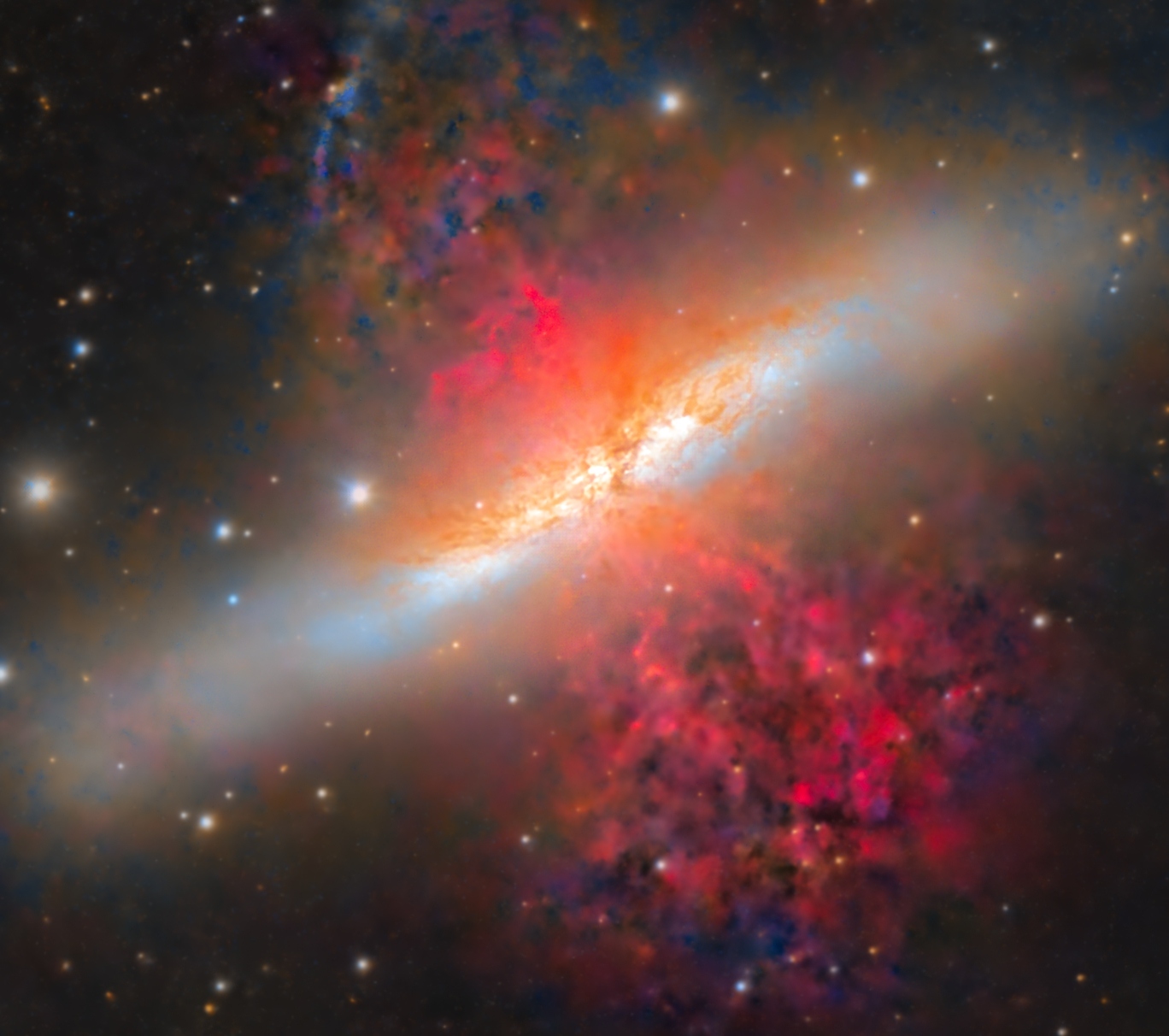
M82 is characterized by its exceptional starburst activity, with a star formation rate approximately ten times higher than that of typical spiral galaxies. This heightened activity is attributed to gravitational interactions with M81.
The central region of M82 is about one hundred times more luminous than that of the Milky Way, highlighting its vigorous star-forming activity. The region is in fact rich in young, massive stars, leading to strong stellar winds and supernova explosions that drive outflows of gas and dust, observable as filamentary structures extending from the galaxy's plane.
The intense star formation in M82 results in substantial infrared emission, and M82 is one of the brightest infrared galaxies in the sky. Infrared observations reveal complex structures of interstellar dust and gas, illuminated by the combined light of the galaxy's stellar population.
Galactic Interaction and Starburst Activity
The close proximity of M81 and M82 has led to significant gravitational interactions, profoundly influencing their respective structures and star-forming activities. Approximately 500 million years ago, a close encounter between the two galaxies induced tidal forces that compressed gas clouds within M82, leading to its current starburst phase. This interaction has made M82 one of the brightest infrared galaxies in the sky.
M82 contains ultraluminous X-ray sources, including M82 X-1, an intermediate-mass black hole candidate, and M82 X-2, a pulsar emitting X-rays at extraordinary luminosities. These objects challenge existing models of stellar evolution and accretion physics. M82 has also been host to several supernovae, the most notable being SN 2014J, a Type Ia supernova discovered in January 2014. Its relative proximity provided astronomers with a valuable opportunity to study such stellar explosions in detail.
The Integrated Flux Nebula
The area around M81 and M82 is known for the presence of Integrated Flux Nebulae (IFN), faint clouds of interstellar dust and gas illuminated by the combined light of the Milky Way. Unlike traditional nebulae lit by nearby stars, IFNs are found at high galactic latitudes and require long exposure times to be detected.
The IFN surrounding M81 and M82 is part of a larger interstellar complex containing dust, hydrogen, and carbon monoxide. These nebulae, particularly visible near the celestial poles, help astronomers study the composition and distribution of interstellar dust.
Discovered in deep-sky surveys, IFNs were first spotted in the Palomar Sky Survey and later mapped in detail using infrared satellites like IRAS and DIRBE. While they can interfere with extragalactic observations, they also provide valuable insight into the structure of the Milky Way’s outer regions.
Observing M81 and M82
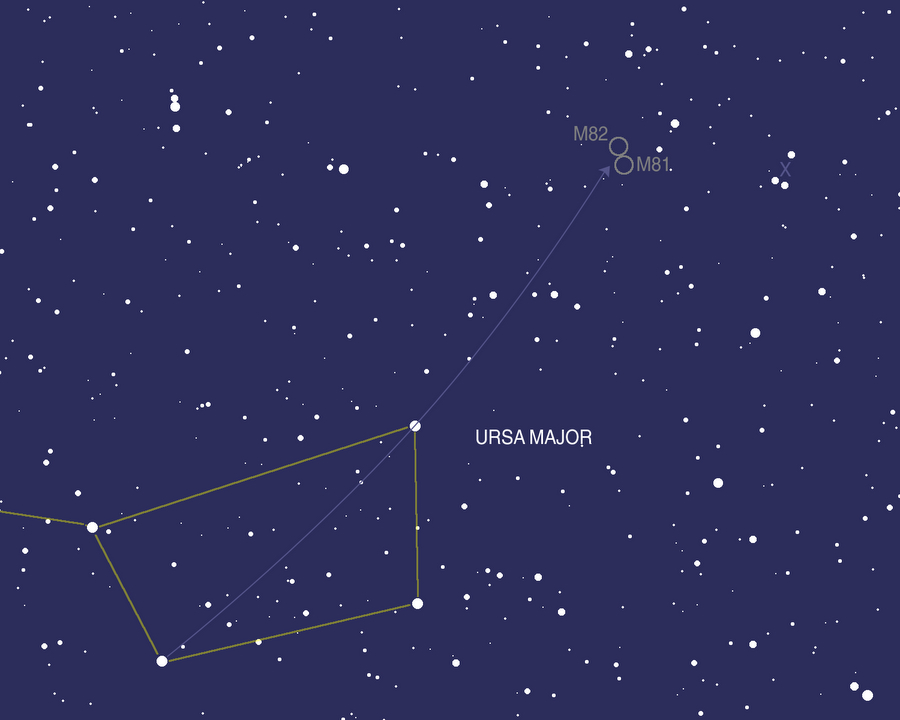
Both galaxies are located in the constellation Ursa Major, making them accessible to observers in the Northern Hemisphere. To locate them, start by identifying the Big Dipper asterism. Extend an imaginary line from the stars Phecda (γ UMa) to Dubhe (α UMa), and continue it for approximately the same distance beyond Dubhe. This will bring you to the vicinity of M81 and M82, which are separated by about 0.6 degrees on the sky—close enough to be observed together in the same field of view using binoculars or a low-power telescope.
The optimal time to observe M81 and M82 is during the spring months, particularly in March and April, when Ursa Major is prominently positioned in the evening sky. During this period, the galaxies reach their highest point above the horizon, providing the best viewing conditions. Under dark skies, away from light pollution, both galaxies can be spotted with binoculars, appearing as faint smudges. A telescope with an aperture of 8 inches (ca. 20 cm) or larger will reveal more structural details, such as the spiral arms of M81 and the elongated shape of M82.